

Definition
Allow an object to alter its behavior when its internal state changes. The object will appear to change its class.
UML class diagram
Participants
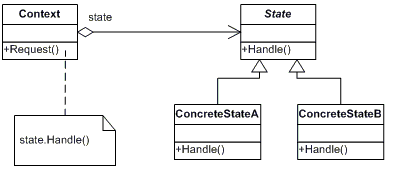
The classes and/or objects participating in this pattern are:
- Context
maintains an instance of a ConcreteState subclass that defines the current state.
- State - defines an interface for encapsulating the behavior associated with a particular state of the Context.
- Concrete State - each subclass implements a behavior associated with a state of Context
Sample code in C#
    #region State

    public interface IState
    {
        void Handle(StateContext context);
    }

    #endregion

    #region Context

    public class StateContext
    {
        #region Properties

        ///
        /// The current inner state
        ///
        public IState State { get; set; }

        ///
        /// An inner counter of this context
        ///
        public int Counter { get; set; }

        #endregion

        #region Ctor

        ///
        /// Construct a new StateContext with the
        /// given first state
        ///
        /// The first state of the object
        public StateContext(IState state)
        {
            State = state;
        }

        #endregion

        #region Methods

        ///
        /// Send a request to be handled by the inner state
        /// behavior
        ///
        public void Request()
        {
            State.Handle(this);
        }

        #endregion
    }

    #endregion

    #region Concrete State

    public class ConcreteStateA : IState
    {

        #region IState Members

        public void Handle(StateContext context)
        {
            context.Counter += 2;
            // change the context state to a new state
            context.State = new ConcreteStateB();
        }

        #endregion

    }

    public class ConcreteStateB : IState
    {

        #region IState Members

        public void Handle(StateContext context)
        {
            context.Counter -= 1;

            // change the context state to a new state
            context.State = new ConcreteStateA();
        }
        #endregion
    }
    #endregion
The implementation of state depends on inheritance. The main issues is to understand that every concrete state is responsible to change the current context behavior to the next context behavior in the chain of behaviors. The
example I gave is simple and can be run with this code
   // initialize a context with a first state behavior

   StateContext context = new StateContext(new ConcreteStateA());

   context.Request();

   Console.WriteLine("The current counter need to be 2: {0}", context.Counter);

   context.Request();

   Console.WriteLine("The current counter need to be 1: {0}", context.Counter);

   context.Request();

   Console.WriteLine("The current counter need to be 3: {0}", context.Counter);

   Console.Read();
-
Average:
-
Liest(1541)
-
Permalink